
Tachyerges salicis (Linnaeus, 1758)
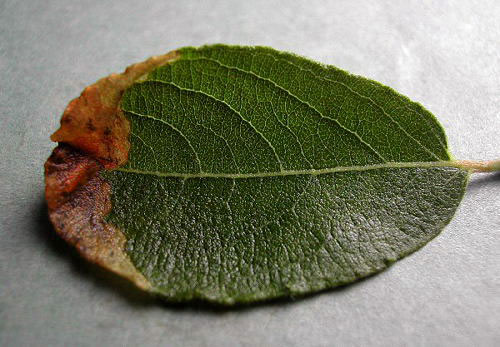
Salix cinerea © Rob Edmunds, UK

Salix caprea, Belgium, prov. Antwerp, Mol; © Carina Van Steenwinkel
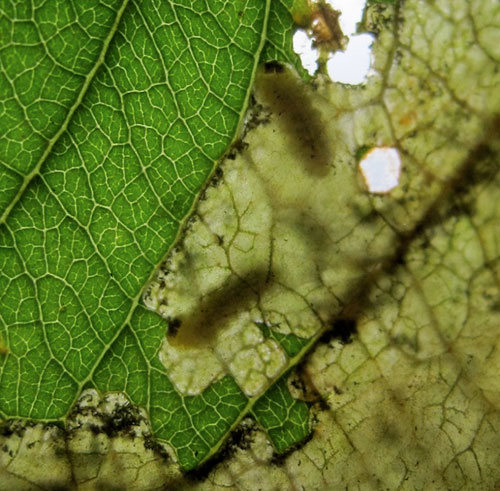
the mine contained several larvae
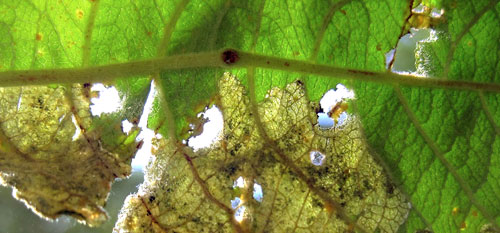
no oviposition scars could be found on the lateral veins; the interpretation of this scar is unclear

pupation in cocoons in the mine; the material has been bred, the identification was confirmed by Marc Delbol
mine
Oviposition in the underside of a lateral vein. From here develops a large, full depth transparent light brown blotch that expands irrespective of the leaf venation. Mine mostly in the distal half of the leaf, may eventually occupy half of its surface. The mine often tears in, and the leaf tip is disfigured. The larva eventually pupates in a globular cocoon within the mine (Scherf, 1964a).
host plants
Salicaceae, oligophagous
Populus nigra, tremula; Salix alba, aurita, caprea, cinerea, fragilis, viminalis.
Salix is the main host plant.
phenology
Larvae in June-August (Hering, 1957a). Bivoltine: late spring and late summer (Robbins, 1991a).
BENELUX
BE observed (Curculionidae.be, 2010).
NE observed (Heijerman, 1993a).
LUX not observed (Fauna Europaea, 2007).
distribution within Europe
From the British Isles to Poland and Russia and from France to Italy and Bulgaria (Fauna Europaea, 2007).
larva
synonyms
Rhynchaenus salicis.
references
Askew (1985a), Buhr (1933a, 1964a), Caillol (1954a), Dieckmann & Herger (1985a), Drăghia (1972a), Heijerman (1993a), Heijerman & van der Leij (1997a), Hering (1930a, 1957a), Kleine (1924/1925a), Maček (1999a), Menet (2012a), Michalska (1972a), le Monnier (2003a), Podlussány (2007a), Rheinheimer & Hassler (2010a), Robbins (1991a), Roques (1998a), Scherf (1964a), Sønderup (1949a), Ugarte San Vicente (2005a), Vorst (2010a), Yunakov, Nazarenko, Filimonov & Volovnik (2018a), Zoerner (1970a).