
Hydromyza livens (Fabricius, 1794)
on Nuphar, ? Nymphaea

Nymphaea alba, Weesp, 29.vii.2024 ©
Cor Zonneveld
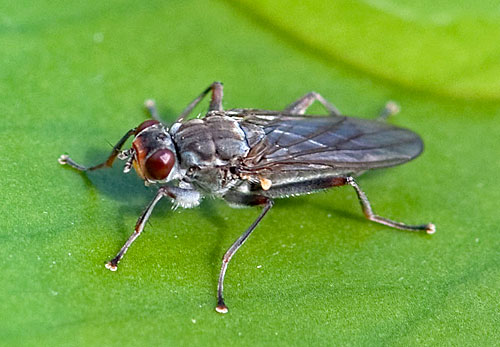
imago

Nuphar lutea, Schellingwoude
mine
Ovipostion at the underside of the leaf, at some distance from the leaf margin. Mines visible from a distance as long, elegant corridors in the leaf upper-surface, often several in a leaf. The corridors run towwards to insertion of the the underwater petiole. From this point the larvae descend as borers into the petiole, and finally pupate there. A part of the pupae is thin-walled, and emerge alreay in August. The other pupae are thick-walled; they hibernate in the petiole and rise the the surface next spring, after the petiole has rotted away (de Meijere, 1895a; Hering, 1957a; Brock & van der Velde, 1987a).
host plants
Nymphaeaceae, oligophagous
Nuphar lutea, pumila
According to Brock & van der Velde (1987a) all references to Nymphaea are erroneous; however, Cor Zonneveld is convinced of his identificiation (photo above).
phenology
Larvae in July (Hering, 1957a)
BENELUX
BE recorded (Gosseries, 1991b).
NE recorded (de Meijere, 1939a).
LUX not recorded (Fauna Europaea, 2007).
distribution within Europe
From Scandinavia to the Pyrenees, and from the UK to Poland and Hungary (Fauna Europaea, 2007).
larva
See Brock & van der Velde (1987a)
synonyms
Nupharia rivularis Robineau-Desvoidy, 1830.
notes
Brock & van der Velde (1987a) present a detailed autecological study of the species.
references
Ball (2007a, 2014a), Brock & van der Velde (1987a), Buhr (1933a), Collins (1958a), van Frankenhuyzen, Houtman & Kabos (1982a), Gosseries (1991b), Hayhow (1999a), Hering (1932d, 1957a), Huber (1969a), de Jong (2002a), de Meijere (1895a, 1939a, 1940c), Püchel (1999a), Robbins (1991a), Sønderup (1949a), Stammer (2016a), Surányi (1942a), Ureche (2010a).