
Neocoenorrhinus pauxillus (Germar, 1824)
apple leaf cutter

Malus domestica, Belgium, prov. Antwerp, Mol © Carina Van Steenwinkel: oviposition scar in the leaf base

withered fallen leaves
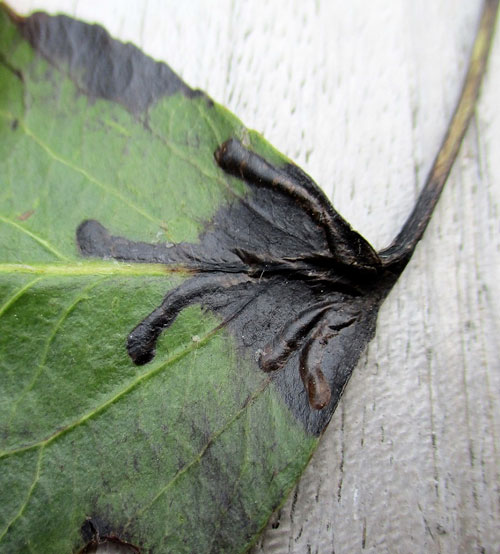
mines
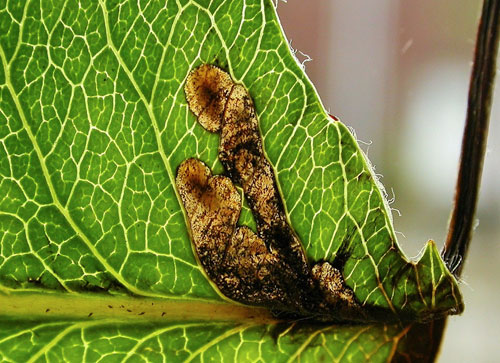
occupied mines, lighted from behind
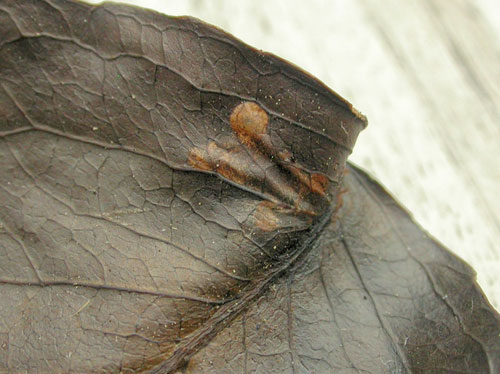
the larvae complete their development in the complete withered leaf
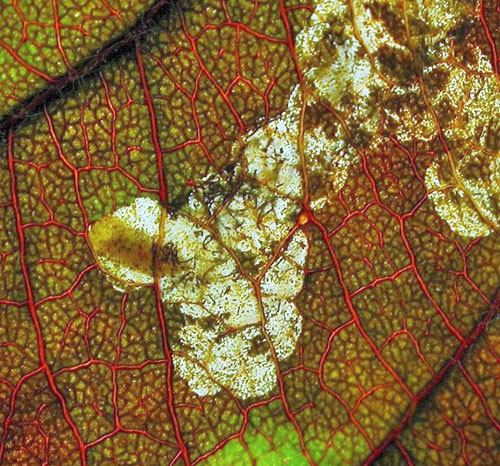
larva: the fresh frass is in thread segments!
mine
The egg is deposited in the base of the midrib. After oviposition the female severes the petiole, causing the petiole to break. The leaf start to wilt and falls, but still remains green for a considerable time. The larva tunnels in the midrib, and makes from there broad, full deep blotches in the lamina. Frass dispersed in the mine. Often several larvae in a leaf. Pupation in the ground. The beetles are ectophagous leaf-eaters. Blommers & Vaal (2002a) and Gønget (2003a) describe the biology in more detail.
host plants, larvae
Rosaceae, oligophagous
Amelanchier lamarckii; Cotoneaster integerrimus, tomentosus; Crataegus laevigata, monogyna; Cydonia oblonga; Malus domestica; Prunus armeniaca, domestica; Pyrus communis.
host plants, beetles
Rosaceae, oligophagous
Prunus serotina.
phenology
Larvae in the first half of June (Dieckmann, 1974a).
BENELUX
BE observed (Curuculionidae.be, 2010).
NE observed (Fauna Europaea, 2007; Heijerman, 1993a).
LUX not observed (Fauna Europaea, 2007).
distribution within Europe
Almost entire Europe; not in Ireland (Fauna Europaea, 2007).
synonyms
Neocoenorrhinidius, Coenorhinus, Caenorhinus, Merhynchites, Rhynchites pauxillus.
notes
Sometimes an orchard pest, especially on apple (Gønget, 2003a).
references
Behne (981a), Blommers & Vaal (2002a), Dieckmann (1974a), Gønget (2003a), Gruschwitz (1999a), Heijerman (1993a), Hering (1957a), Meijer, Smit, Beukeboom & Schilthuizen (2012a), Rheinheimer & Hassler (2010a), Robbins (1991a), Scherf (1964a), Sprick (1990a), Vorst (2010a), Yunakov, Nazarenko, Filimonov & Volovnik (2018a).