
Monochroa conspersella (Herrich-Schäffer, 1854)
dingy neb

Lysimachia vulgaris, België, prov. Antwerpen, Kalmthoutse Heide, 31.viii.2013 © Steve Wullaert

Mines mainly at the leaf tip

Lysimachia vulgaris, Belgium, prov. Antwerp, Kasterlee, de Tikkebroeken, 15.viii.2018 0 © Carina Van Steenwinkel: young mine in transparency

Lysimachia vulgaris, Belgium, prov. Antwerp, Oud-Turnhout, de Liereman, 9.ix.2016 © Carina Van Steenwinkel: the mine is strongly contracted

Lysimachia vulgaris, Belgium, prov. Antwerp, Mol, Buitengoor-Meergoor, 30.viii.2014 © Carina Van Steenwinkel, old, vacated mine

Lysimachia vulgaris. Belgium, prov. Namur, Gerhoeven, de Rammelaers, 5.v.2020 © Carina Van Steenwinkel; det. Tymo Muus: disfigured top of the plant

freely living larva
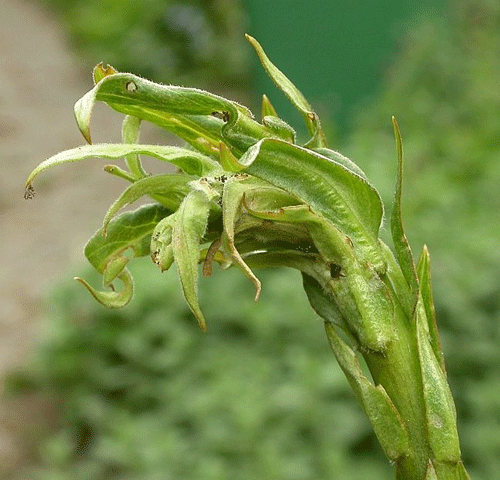
Lysimachia vulgaris, Belgium, prov. Antwerp, Meerhout, de Kwachten, 1.v.2020 © Carina Van Steenwinkel

the larva feeds on the leaves, does not mine any more

Lythrum salicaria, Castricum, 9.ix.2020,© Sandra Lamberts: vacated mine; see the discussion below
mine
Lower surface blotch without folds, with irregular corridor-like extensions; centre of the mine brownish. The mine usually starts at the tip of the leaf. Frass dispersed. After the hibernation the larve lives between spun leaves and does not mine any more (Klimesch, 1958a).
host plants
Primulaceae, monophagous
Lysimachia vulgaris.
Older sources, including Hering (1957a), also mention Lythrum salicaria as a host plant, but this is not confirmed by Elsner ao (1999a) or Bland ao (2002a). Sattler (1974a) and Wieser & Huemer (1999a) explicitly call the species monophagous on Lysimachia. At the other hand, the mine as depicted above from Castricum, does not agree with any of the species certainly known from Lythrum.
phenology
Larvae mine from September till the onset of winter (Hering, 1957a).
BENELUX
BE recorded (Phegea, 2010).
NE recorded (Kuchlein & de Vos, 1999a; Microlepidoptera.nl, 2010).
LUX recorded (Fauna Europaea, 2010).
distribution within Europe
From Fennoscandia and East-Russia to the Pyrenees, Sicily, and Albania, and from Britain to the Ukraine (Bland ao, 2002a; Fauna Europaea, 2010).
larva
larva, pupa
See Lepiforum, Patočka (1997a), Patočka & Turčáni (2005a).
synonyms
Monochroa, Xystiphora morosa (Mühlich, 1864).
notes
Hering (1957a) states that after the hibernation the larva lives as a stem borer. Bland ao (2002a) only write that bark mines are made, and that “young leaves are eaten to a lesser extent”, suggesting moreover that this happens in spring rather than in autumn. It remains to be seen if the same species is involved in these publications.
references
Bland, Corley, Emmet ao (2002a), Buhr (1935b, 1964a), van Deventer (2021a), Elsner, Huemer & Tokár (1999a), Emmet (2023c), Hering (1957a), Huber (1969a), Huisman & Koster (1994a, 1997a), Huisman, Koster, van Nieukerken & Ellis (2009a), Huisman, Koster, van Nieukerken & Ulenberg (2001a, 2004a, 2006a), Junnilainen, Karsholt, Nupponen, ao (2010a, Kaitila 1996a), Klimesch (1958a, 1989a), Kovács & Kovács (2022a), Kuchlein & Donner (1993a), Kuchlein & de Vos (1999a), Lepiforum (2026), van Nieukerken, Gielis, Huisman ao (1993a), Parsons (1995a), Patočka (1997a), Patočka & Turčáni (2005a), De Prins (1998a), De Prins & Steeman (2013a, 2014a), Sattler (1974a), Segerer & Grünewald (2013a), Sinev & Shapoval (2015a), Skala (1950a), Skala & Zavřel (1945a), Slootmaekers & De Prins (2015a), Sønderup (1949a), Szőcs (1977a), Tuinstra (2021a), Wieser & Huemer (1999a).